
High Speed Electrospindle Motor Design - 24,000rpm 15kW 6.2Nm
Engine design is an iterative process aimed at obtaining the best configuration to meet the project requirements, made possible largely by experience. In order to make the text more fluent, the main stages have been represented. Customer data input:
| stator diameter (mm) | 120 |
| stator height (mm) | 60 |
| max. speed (rpm) | 26.000 |
| power (kW) | 15 |
The work starts with the search for a suitable stator plate, taking into account the starting data provided by the customer as expressed in the table above. This first operation is a trade-off between being able to use a sheet metal already available and therefore cheaper, or making a custom one, which is more expensive.
Once the correct sheet metal is found, the stator drawing is entered into the programme and the appropriate rotor is matched. The motor structure (housing) with its cooling system, shaft, bearings etc. is then entered into the programme. Then rotor is designed: the geometrical characteristics and bar design; the stator slot is also constructed, where the winding data is entered: number of turns, pitch, wire diameter etc..

Vista d’insieme del motore comprensivo di chassy
Overall view of the engine including chassy
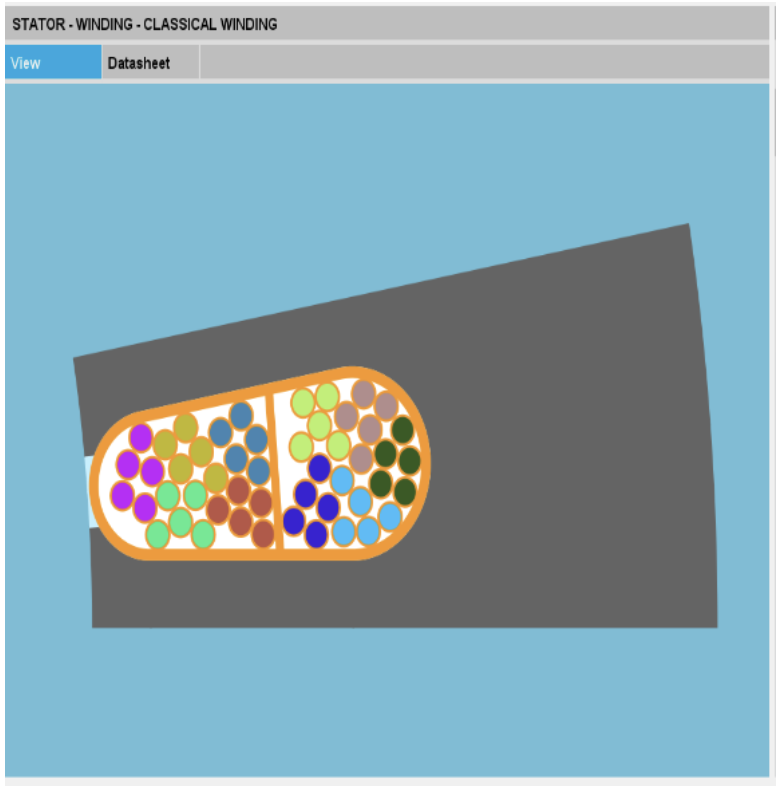
Sezione cava con avolgimento
Hollow section with winding
Having entered the motor geometries, simulations using the Finite Element method are launched to characterise the no-load and locked rotor equivalent circuits describing the electromagnetic characteristics of the motor.

No load simulation
No load simulation

Locked motor simulation
Locked motor simulation

Schema circuito equivalente
Equivalent circuit diagram
The results suggest the correct functioning of the sketched motor. In the event of unsatisfactory results, we modify the initial data according to the know-how and criteria defined by experience and theory that lead to the best result: e.g. the type of sheet metal, the shape of the slot, etc.
Once the basic configuration is obtained, the motor is analysed in the working point range specifically requested by the customer, in this case: 24,000rpm:
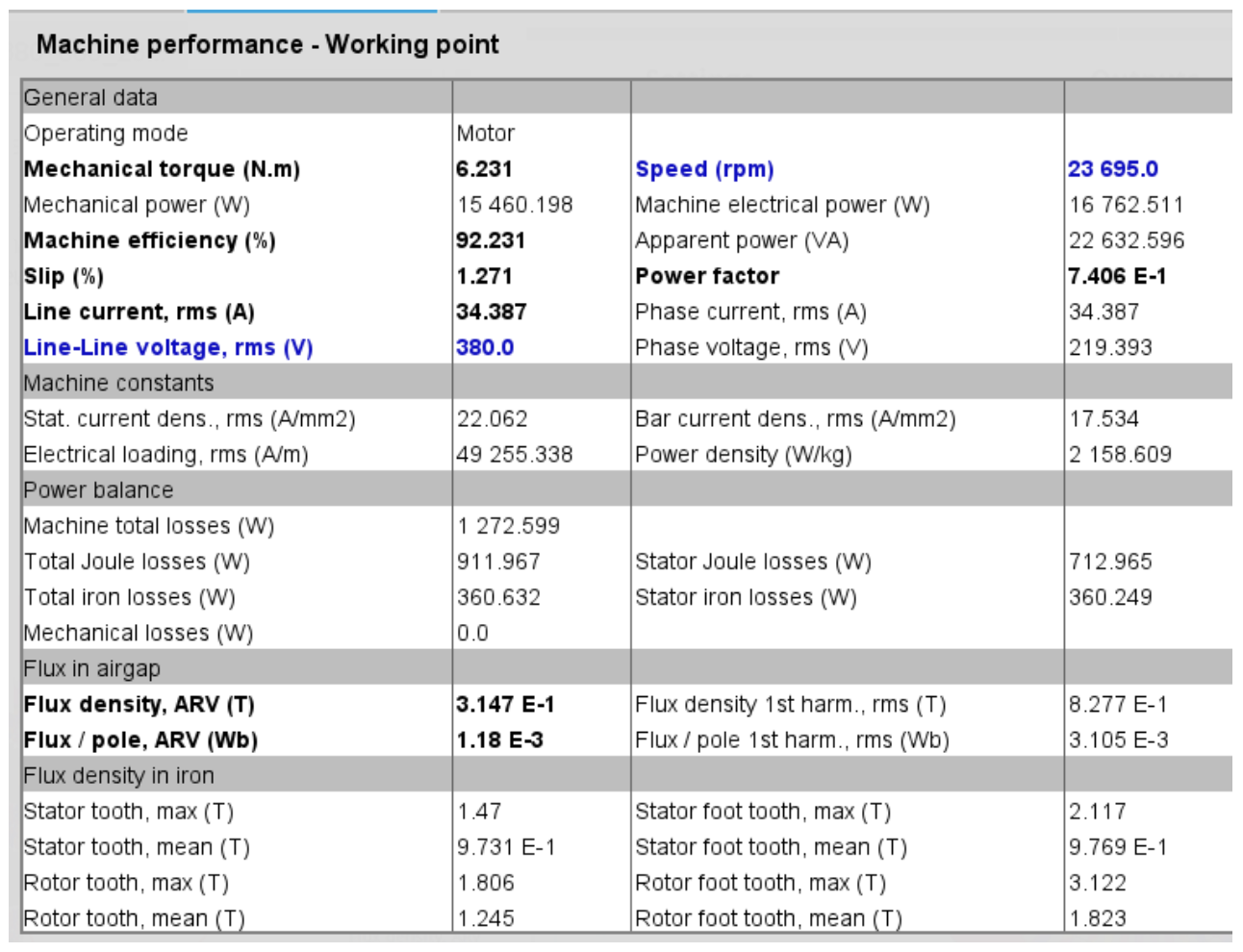
“It can be seen that at 23,695rpm there is a torque of 6.231Nm and efficiency of 92.3%.”
We then move on to an analysis of the magnetic flux inside the motor. Both graphs determine the points of inefficiency and therefore possible heating. An attempt is then made to have continuous flux lines, while for the density, the capacities of the material are exploited to the maximum without exceeding its limits so as not to create local inefficiencies that could trigger a malfunction: vibration, noise, heat, etc.
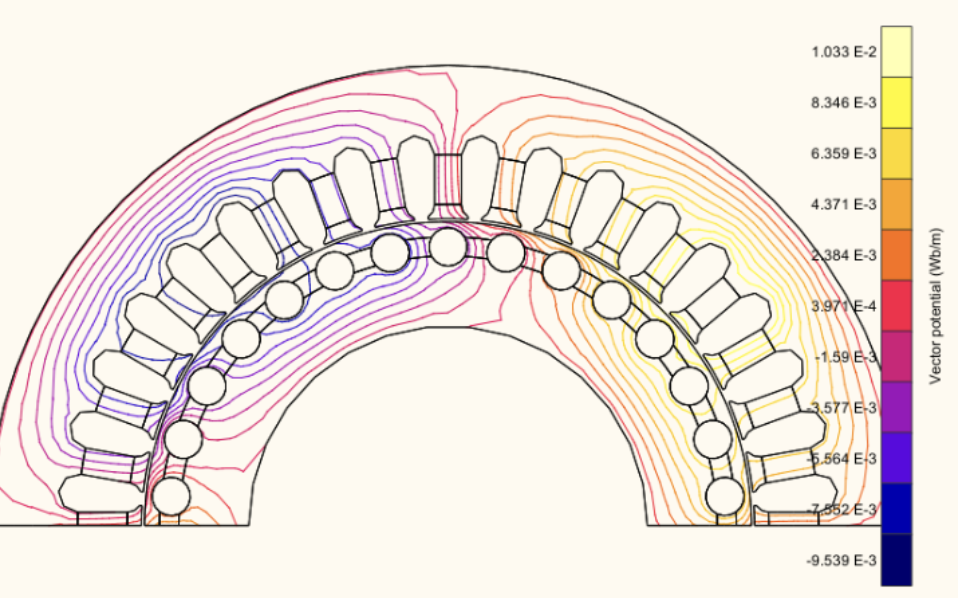
Linee del flusso, tutte continue non spezzate
Flow lines, all continuous not broken

Grafico densità di flusso
Flow density graph
A very important understanding is then the analysis of HARMONICS, in order to look for any harmonics that interfere with engine operation. The harmonics that do not contribute to creating torque, also generating heat, noise and vibrations, are those of the 3rd order and its multiples (6,9 etc.).
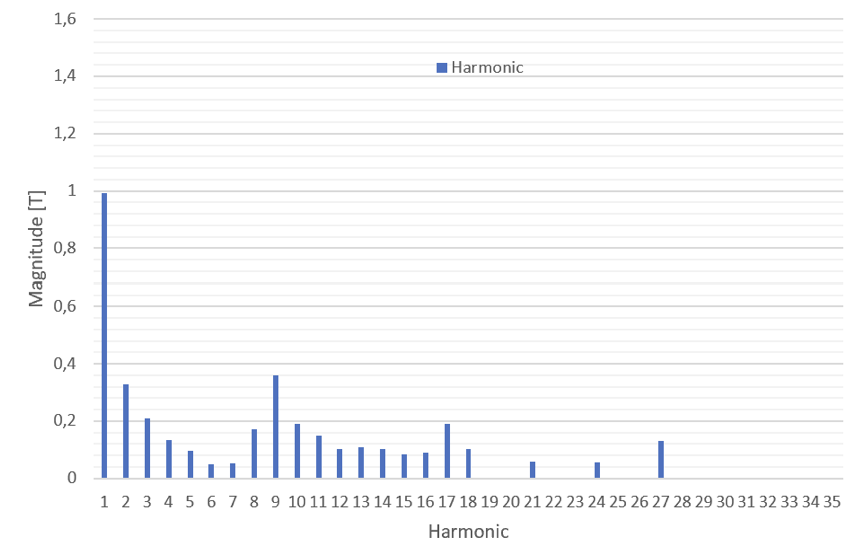
Armoniche iniziali
Initial harmonics

Armoniche dopo ottimizzazioni
Harmonics after the motor optimizations
For the engine in question, the first simulations showed significant values of third-order harmonics and multiples. By making a series of changes to the construction parameters based on experience and know-how, it was seen that changing the number of rotor bars resulted in a clear improvement in harmonics.
You can see in the second image the near elimination of third-order harmonics and multiples, and an increase in the value of the first-order harmonic: from a value of 1 to 1.4, which is an indication of improved performance since this is the harmonic directly related to motor performance.
Having optimised the harmonics and verified the performance, a final general engine mapping simulation is carried out, which determines:
- Engine characteristics at start-up
- Optimum working point
- Break down torque
The output is the torque, power and voltage curve as a function of frequency:
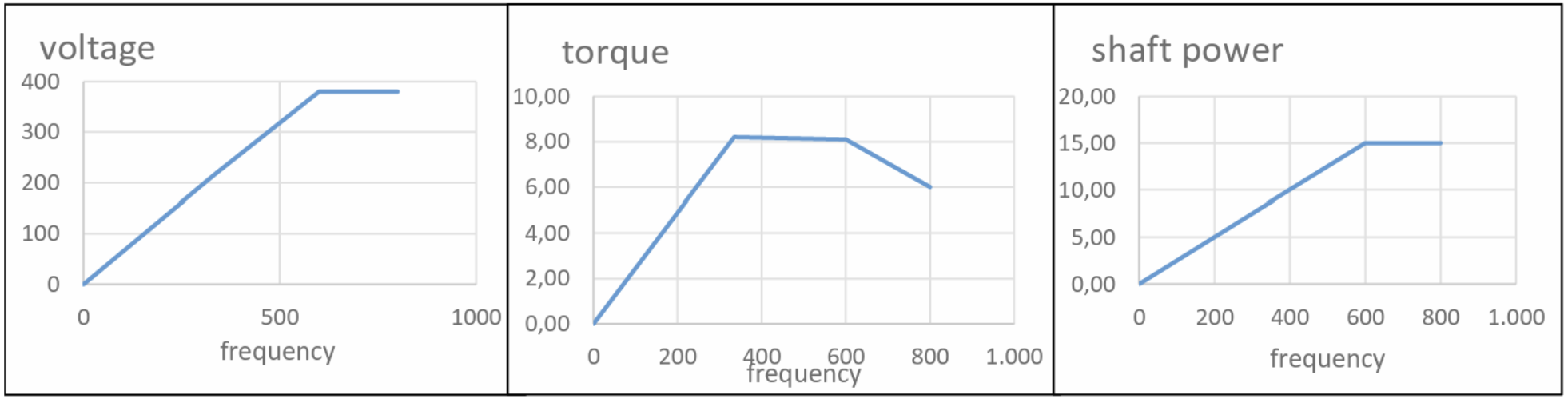
Once all the data are verified, we are able to realize the data sheet for customer verification, with the parameters for the inverter drive.
Once the specifications and data sheet are confirmed, we have all the data to realize the first sample motor.
FINAL NOTE: In parallel with the performance analysis, thermal dimensioning is also carried out so that the actual thermal conditions of use can then be used to determine the actual operating data. We will see this analysis in detail in another page.

MotorLift S.r.l.
Strada Statale per San Martino 2
26867 – Somaglia (Lodi)
info@motorlift.it
+39 0377 570175
P.iva: 09957250963
- Azienda
- Motori per ascensori
- Motori su misura
- Elettromandrini
- Informativa privacy
- Informativa cookie